

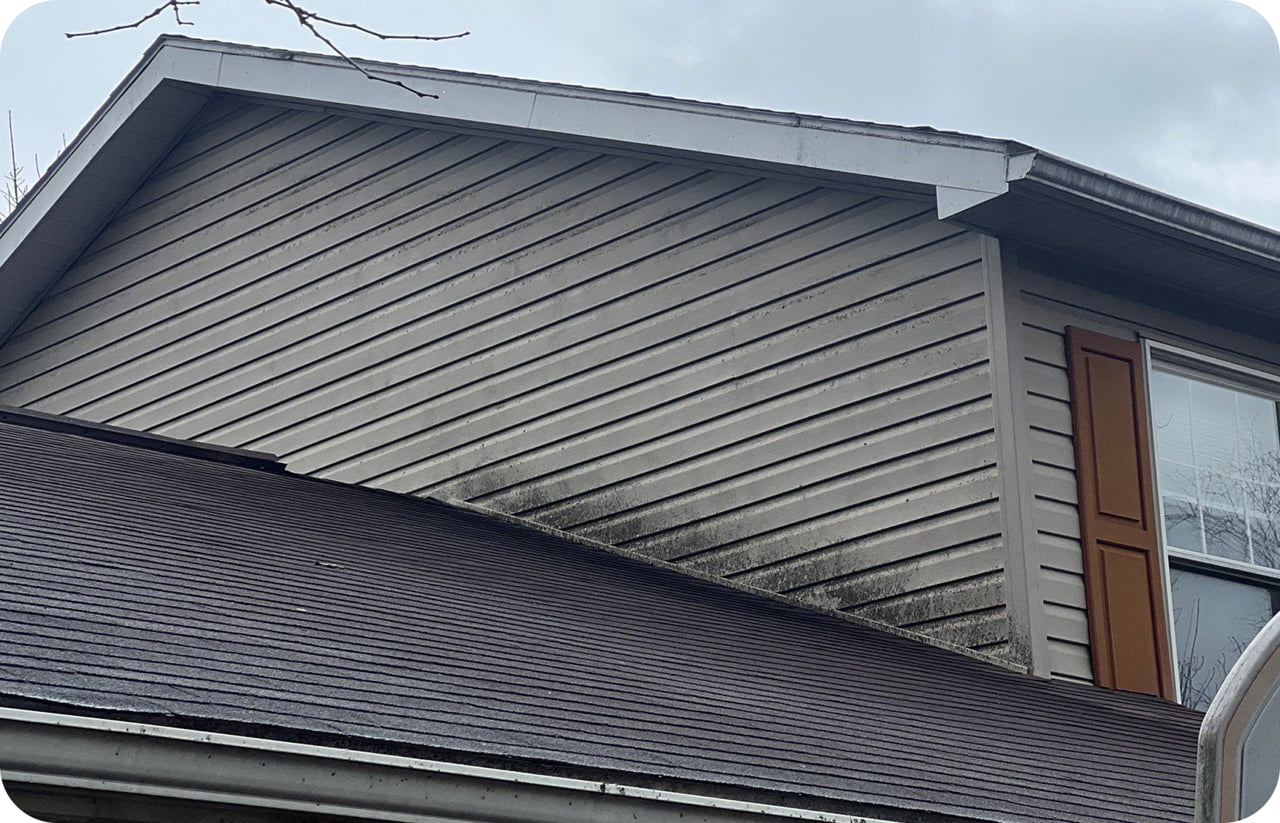
If you have driven through any neighborhood in Northumberland County, you have seen it. Dark streaking running down the roof sections. Black discoloration is spreading from the ridge toward the eaves. Green patches are forming in the shaded corners. Most homeowners assume it is dirt. Or weathering. Or just what older roofs look like. It is none of those things.
What Is Actually Causing the Black Streaks
The dark streaking on residential roofs throughout central Pennsylvania is caused by a photosynthetic bacterium called Gloeocapsa magma. It produces a dark-pigmented sheath around its cells as a defense against ultraviolet radiation. That dark pigment is what you see as the black and gray streaking on your roof. The organism is alive, actively feeding on the limestone filler used in asphalt shingles, and spreading across the roof surface from spores carried by wind, birds, and insects. It is not a stain. It is a living colony.
Why Central Pennsylvania Is Particularly Affected
Gloeocapsa magma thrives in warm, humid conditions with periodic moisture. The Susquehanna River valley creates elevated ambient humidity that keeps roof surfaces moist longer after rain events. The dense tree canopy common throughout Northumberland, Snyder, Union, and Columbia counties shades roof sections and prevents UV radiation from naturally suppressing algae growth. Summer temperatures in the region are warm enough to support active biological growth for five to six months of the year.
What the Algae Does to Your Shingles
Gloeocapsa magma feeds on the limestone carbonate filler that manufacturers use in asphalt shingles, gradually depleting the limestone component and weakening the material over time.
The organism also holds moisture against the shingle surface, retaining moisture rather than allowing it to run off. That retained moisture accelerates the freeze-and-thaw cycle damage caused by Pennsylvania winters.
Lichen compounds the problem further. Lichen attaches to the shingle surface with root-like structures called rhizines. As lichen grows, it physically lifts shingle granules from the surface. Granule loss is irreversible.
What Soft Washing Does That Pressure Washing Cannot
The treatment for Gloeocapsa magma and lichen is chemical rather than mechanical. Pressure washing removes what is visible on the surface but leaves the root biology intact. Within weeks, the organisms regrow from the untreated root system.
Soft washing kills the biology. The cleaning solution penetrates the growth and treats it at the cellular level. This is the only method that produces results lasting more than a season on a Pennsylvania roof.
For roof cleaning in Northumberland, PA, that permanently removes dark streaking, Kleen-N-Brite uses the soft wash method on every job.
