

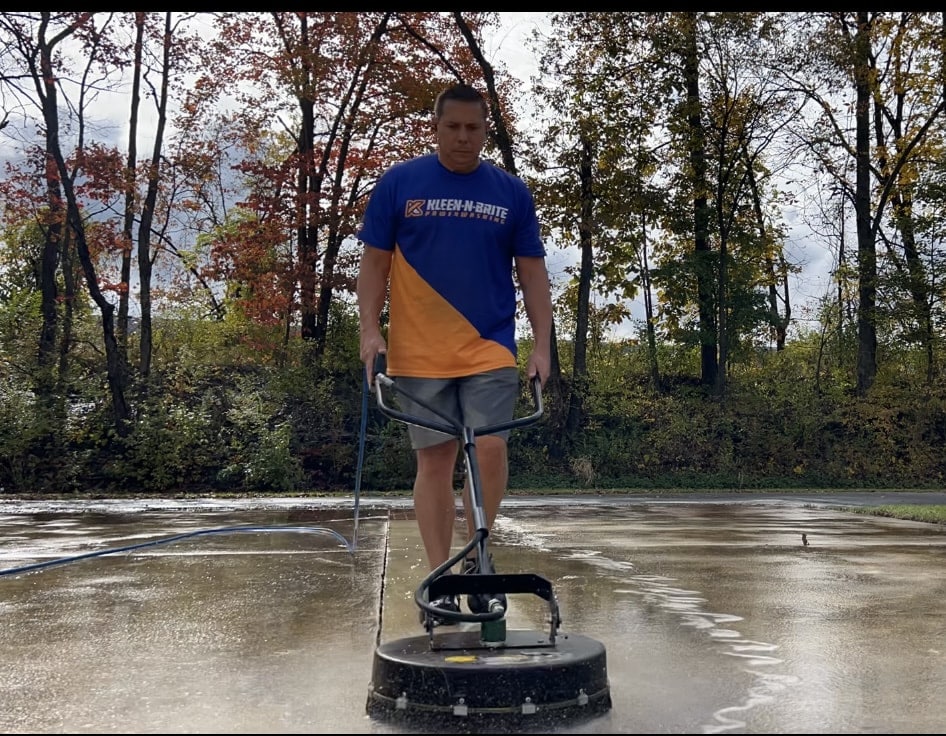
You’ve probably noticed it already. That dull green haze creeping across the shaded end of the driveway, the same spot where the maple drops its leaves every October. Most homeowners assume algae is a spring problem, something that shows up with the April rain and gets dealt with once the weather warms back up.
That assumption costs people more than they realize. Algae does not go dormant just because the calendar turns to fall. It keeps growing right through the wet, cool weeks of October and November, and if it is still sitting on your concrete when the first hard freeze hits, it makes the whole winter harder on your driveway than it needs to be.
Here’s what you’ll walk away knowing: why fall conditions in Northumberland County are just as friendly to algae as spring, what happens when that algae layer gets trapped under ice and snow all winter, and why right now, before the first freeze, is actually the smarter time to have it cleaned.
Why Algae Doesn’t Take the Fall Off
Algae needs three things to spread: moisture, shade, and a surface to hold onto. Spring gets blamed for providing all three, but fall provides them just as reliably, sometimes more so.
Shorter days mean less drying time.
As daylight hours shrink through October, any section of your driveway that sits in shade gets even less sun exposure to dry it out between rain events. A driveway that dried out fine in July can stay damp for days at a time by late October.
Falling leaves trap moisture against the surface.
Leaf litter does more than look messy. It holds moisture directly against the concrete, creating a damp microenvironment that stays wet long after the surrounding pavement has dried.
Clay-heavy Pennsylvania soil keeps drainage slow.
Soil throughout the Susquehanna Valley has a high clay content, and clay drains more slowly than sandy or loamy soil. Penn State Extension notes that clay soils are common across much of the state, and their dense structure means water moves through them far more gradually. That slower drainage keeps the ground around your driveway saturated well into the fall, right up until the ground freezes.
So while everyone else is thinking about pumpkins and football, algae is quietly having one of its best seasons of the year on the shaded edge of your driveway.
What Happens When You Leave It There Through Winter
This is the part most homeowners never think about. Algae is not just a cosmetic issue. It is a layer of biological growth that holds moisture against the concrete surface, and that matters a great deal once temperatures drop below freezing.
Concrete is porous. When water sits in those pores and then freezes, it expands by roughly 9 percent in volume, putting pressure on the surrounding material from the inside. That pressure causes surface flaking, small cracks, and rough patches known as spalling. An algae layer holds extra moisture right at the surface, which means more water is available to freeze and expand every time the temperature drops overnight, then thaw the next afternoon again. Through a typical central Pennsylvania winter, that freeze-thaw cycle can repeat dozens of times.
In other words, a driveway that goes into winter already carrying a layer of algae is set up for more surface damage than a clean one, not because the algae itself eats away at the concrete, but because of what it holds in place as temperatures swing.
Why This Makes Fall the Better Time to Clean, Not Spring
Waiting until spring means the algae has had an entire winter to sit against your concrete while it freezes and thaws, again and again. Cleaning it now, before that first hard freeze, removes the moisture-holding layer before it has the chance to make winter’s freeze-thaw cycle any worse than it already is.
There’s a practical scheduling advantage too.
Concrete cleaning in October and November tends to book out faster than most people expect, precisely because fewer homeowners think about it this time of year. Getting it done now, rather than waiting for the spring rush when every driveway in the county wants attention at once, is often the easier appointment to land.
What This Looks Like on a Real Northumberland County Driveway
Picture a driveway in Danville or Selinsgrove with mature trees lining one side. By late October, the shaded half is holding on to a visible green tint, while the sunnier half still looks relatively clean. That contrast tells us exactly where moisture is lingering on your property, which shapes both how we clean it and what we flag for you afterward, whether that’s a downspout draining the wrong direction or a low spot in the grade worth knowing about before winter.
Your Next Step
You take care of this property all year, not just when the weather is easy. The green film on your driveway right now is not a sign you missed something. It is central Pennsylvania doing what it does every fall. The difference is that dealing with it now, before the ground freezes, protects your concrete through the winter ahead, rather than leaving it to fend for itself.
Get a free estimate before the season turns.
We’ll walk the property with you, point out exactly where moisture is collecting, and provide a clear written quote before anything starts. Where Dirty Meets Clean, all year long.
Frequently Asked Questions
Does algae actually grow in the fall, or does it just look worse from summer buildup?
It genuinely keeps growing through fall. Cooler, wetter conditions combined with shorter days and less sun exposure create an environment in which algae thrives, not just one where old growth becomes more visible.
Is it worth cleaning my driveway in the fall if I'm just going to deal with snow and ice on it anyway?
Yes. Removing the algae layer before winter reduces the amount of moisture trapped against the concrete surface, which lowers the impact of the freeze-thaw cycles that cause surface damage over the winter months.
Will pressure washing my driveway in cold weather cause any problems?
As long as temperatures are above freezing at the time of service, cleaning concrete in fall is safe and effective. We schedule around weather to make sure conditions are right.
How does leaving algae on concrete through winter actually cause damage?
Concrete is porous, and water trapped in those pores expands when it freezes. An algal layer traps extra moisture at the surface, increasing the amount of water available to freeze and thaw repeatedly, contributing to surface flaking and small cracks over time.
Should I wait until spring to have my driveway professionally cleaned?
Waiting means the algae sits against your concrete through the entire freeze-thaw season first. Cleaning in the fall removes that layer before winter, rather than after the damage has already accumulated.
How far in advance should I schedule fall concrete cleaning?
As soon as you notice the growth starting, ideally before the first hard freeze. Fall scheduling tends to move faster than people expect since most homeowners aren’t thinking about pressure washing this time of year.
Does salt used for ice make this worse?
Yes. Deicing salt lowers the freezing point of surface water, which can increase the number of freeze-thaw cycles a driveway experiences over the winter. Starting the season with a clean, algae-free surface gives your concrete one less variable working against it.
DERRICK SLODYSKO BIO:
Derrick Slodysko is the owner and operator of Kleen-N-Brite Power Washing, a residential pressure washing company serving homeowners throughout Northumberland, Snyder, Montour, Union, and Columbia counties since 2018. Derrick runs every job personally, from the initial property walkthrough to the final inspection before he leaves, and has built the business on a simple standard: treat every property with the same care you’d want shown to your own home.
Kleen-N-Brite is a member of the Pressure Washing and Restoration Contractors Association (PWNA) and the United Association of Mobile Contract Cleaners (UAMCC), and carries full general liability insurance on every job. That hands-on approach has earned the company over 250 consecutive five-star Google reviews from homeowners across the region, with customers consistently pointing to the same things: attention to detail, care with landscaping and property, and a final walk-through that catches what other companies miss.
When he’s not on a job, Derrick can often be found training his son, who works alongside him during the season, and staying close to the Northumberland community he’s spent his career serving.
