

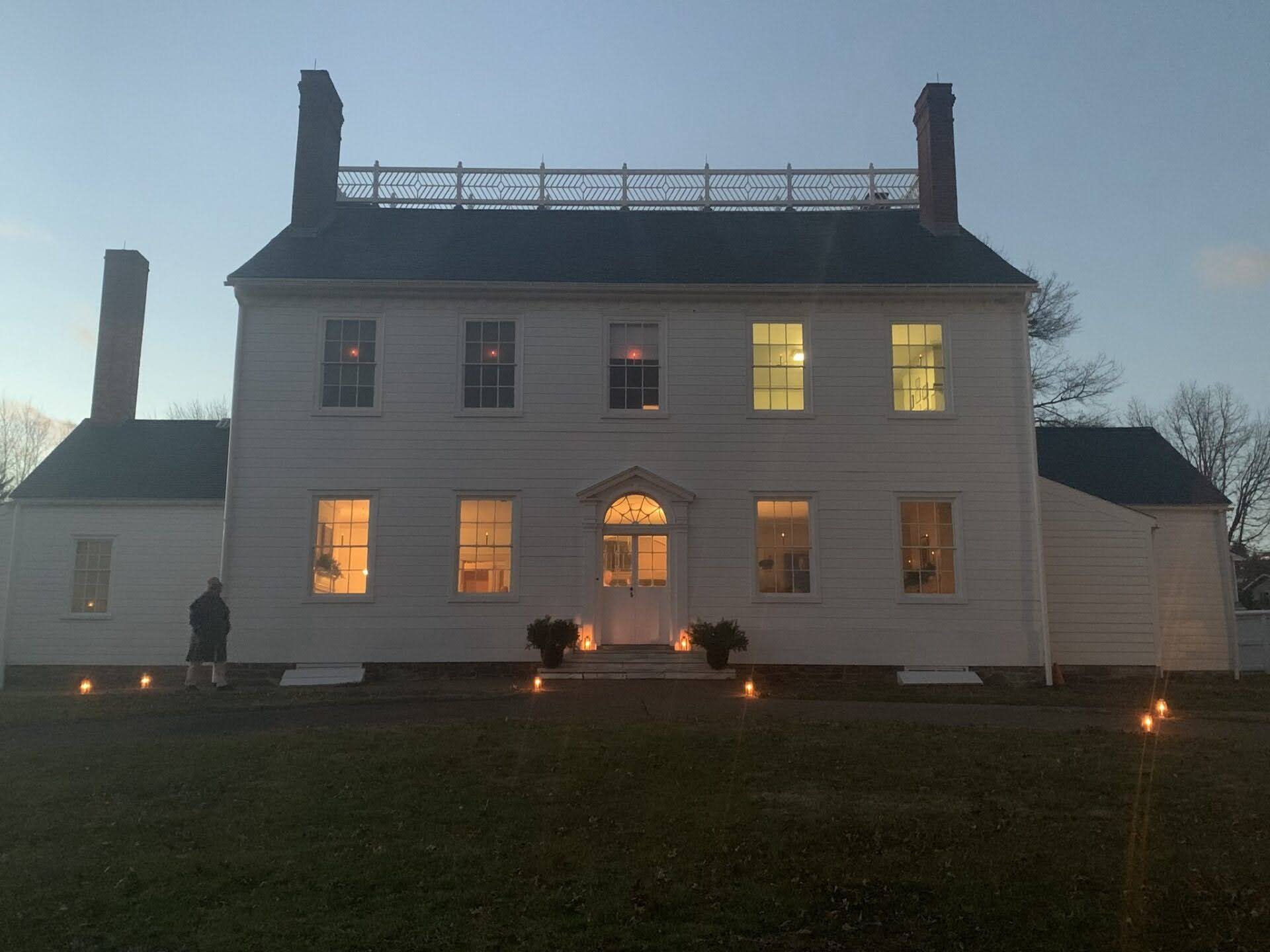
You’ve probably driven past it more times than you can count. It’s the white clapboard house sitting up on the rise above the river, the one most of us roll by on the way across the bridge to Sunbury without a second look. Most people assume that if something world-changing had happened in their own hometown, they would have heard about it by now.
That assumption leaves many locals missing one of Pennsylvania’s best stories. The Joseph Priestley House in Northumberland, PA, was home to the man who discovered oxygen and his laboratory. He spent his last ten years here doing some of the most advanced chemistry in the country, right on the banks of the Susquehanna.
Here’s what you’ll walk away knowing: what Priestley actually discovered in England versus what he discovered here, why an angry mob drove him out of his home country, and how Thomas Jefferson came to call his life precious to mankind, and how to see the house for yourself before the tour season closes.
Priestley Discovered Oxygen in England, but His Story Didn’t End There
This detail trips people up, including many visitors who drive specifically to see the house. Priestley discovered oxygen on August 1, 1774, in a working laboratory at Bowood House in Wiltshire, England, twenty years before he ever set foot in Pennsylvania.
What he accomplished in Northumberland is still remarkable in its own right. In his backyard laboratory, Priestley became the first to isolate carbon monoxide, a gas he called “heavy inflammable air,” and he kept working steadily through his American years, publishing more than thirty scientific papers from this small river town.
So the next time someone tells you oxygen was discovered in Northumberland, you can set the record straight, and the true version turns out to be the better story anyway.
Why an Angry Mob Drove Priestley Out of England
Priestley was never just a scientist. He was a minister, a teacher, and an outspoken supporter of both the American and French revolutions, and those views made him a target in a country growing nervous about revolution reaching its doorstep.
The 1791 riots took nearly everything he had.
In 1791, a “Church and King” mob in Birmingham turned on Priestley and burned his home at Fair Hill, along with his library, his laboratory, and his church. Years of research, notes, and equipment disappeared in a single stretch of violence, the kind of loss most of us can’t imagine recovering from.
He followed his family to America.
Priestley stayed in England for three more years before sailing to the United States in 1794. His sons had already crossed ahead of him, and that decision shaped everything that came next.
Family won out over Philadelphia.
Philadelphia was the country’s biggest city at the time, and its leaders invited him to stay. Priestley turned them down. His sons had settled in Northumberland, so he made the roughly five-day trip north to join them, trading city life for a frontier river town where he would spend the rest of his days.
How Thomas Jefferson and Early America Welcomed Him
Priestley arrived with friends in high places. He already knew Benjamin Franklin, and over the years he built a close friendship with Thomas Jefferson that influenced both men’s thinking.
The welcome wasn’t always warm, though. Through the late 1790s, his reputation as a political radical drew suspicion from some American leaders, and that tension didn’t really ease until Jefferson won the presidency. After that, Jefferson consulted Priestley on the University of Virginia curriculum, and in an 1801 letter he described Priestley’s life as “one of the few lives precious to mankind.”
Priestley also gave back to his new hometown. He pushed to establish the Northumberland Academy, hoping to plant a publicly supported college right here in the borough. The academy didn’t last, but the effort says a lot about how he saw this place, not as a hideout from his troubles, but as home.
What Happened Inside Priestley’s Backyard Laboratory
The American Chemical Society, which dedicated a landmark plaque at the house in 1994, describes Priestley’s lab as probably the best in the country at the time. That’s a big claim for a small town, and the history supports it.
The lab came first.
Priestley’s wife, Mary, designed the house around her husband’s work. Construction ran from 1794 to 1798, and the laboratory was the first part of the property finished. Built from kiln-dried lumber with white clapboard siding, the house faces the river, with two matching wings housing the summer kitchen and the lab. By the standards of the day, no other home in Northumberland came close to its size.
The library rivaled the lab.
Priestley’s book collection grew to roughly 1,600 volumes. In 1920, chemist Edgar Fahs Smith called the house “a Mecca for all who would look back to the beginnings of chemical research” in America.
The house helped launch American chemistry.
Priestley died in the house on February 6, 1804. Seventy years later, chemists from across the country gathered in Northumberland to mark the centennial of his oxygen discovery, and that meeting led to the founding of the American Chemical Society in 1876. Four more generations of Priestleys stayed in the borough, and the family name still lives on in the Joseph Priestley Memorial Chapel and the Priestley-Forsyth Memorial Library.
In other words, one of the country’s largest scientific organizations traces its roots to a gathering in our own backyard, and not many towns this size can say that.
What a Visit Looks Like on a Real Northumberland Weekend
Picture a cool Saturday afternoon in October. You park along Priestley Avenue, walk up the circular drive, and step into the same rooms where Priestley wrote, read, and ran his experiments more than two centuries ago.
The Pennsylvania Historical and Museum Commission owns the site, and the Friends of Joseph Priestley House run it as a museum, so the whole visit fits easily into a single afternoon.
Step 1:
Pick a weekend. The house opens Saturdays and Sundays from 1 p.m. to 4 p.m., from early March into mid-November, and groups can book other times by appointment with advance notice. Check the museum’s website for this season’s exact dates before you go.
Step 2:
Tour the house and lab. You’ll find it at 472 Priestley Avenue. At last check, admission was $8 for adults, $6 for seniors, AAA members, and veterans, and $4 for kids ages 3 to 11; children under 3 and active-duty military families got in free.
Step 3:
Walk the borough. The Joseph Priestley Memorial Chapel and the Priestley-Forsyth Memorial Library both sit within a short walk of the house. Before you leave, stand on the lawn facing the river and take in the same view Priestley woke up to every morning.
The tour season wraps up in mid-November, and the doors stay closed until spring. If you’ve been meaning to go for years, this fall is a good time to finally do it.
Your Next Step
You take care of your home the same way this town has cared for the Priestley House, through every humid summer and every freeze-thaw winter the Susquehanna Valley throws at it. That white clapboard has faced the same river humidity and the same tree shade your siding faces every year, and it’s still standing because people kept showing up for it.
Visit the Priestley House this weekend. Then, when you get home and take a good look at your own siding, see how a gentle, soft wash protects older homes like yours.
Derrick has been doing that work in this borough since 2018, and more than 250 neighbors across five counties have left five-star reviews about the experience, read what they’re saying.
Get a free estimate or give us a call at (570) 500-2535 whenever you’re ready. We’ll walk the property with you, protect your plants and landscaping, and finish with a walk-through before we leave. Where Dirty Meets Clean, right here in Priestley’s hometown.
Frequently Asked Questions
Was oxygen really discovered at the Joseph Priestley House in Northumberland?
No. Priestley discovered oxygen on August 1, 1774, at Bowood House in Wiltshire, England. He moved to Northumberland twenty years later and continued his research in the laboratory he built here.
What did Joseph Priestley actually discover in Northumberland, PA?
He became the first to isolate carbon monoxide, which he called “heavy inflammable air.” He also published more than thirty scientific papers during his years in Pennsylvania.
Where exactly is the Joseph Priestley House?
The house sits at 472 Priestley Avenue in Northumberland, PA 17857, on a rise above the North Branch of the Susquehanna River, with the front facing the water.
When can I tour the Joseph Priestley House?
The museum opens Saturdays and Sundays from 1 to 4 p.m., from early March into mid-November. Visits at other times can be arranged by appointment with advance notice.
How much does it cost to visit the Priestley House?
At the last check, adults paid $8, seniors, AAA members, and veterans paid $6, and kids ages 3 to 11 paid $4. Children under 3 and active military families get in free.
Why did Priestley pick Northumberland instead of Philadelphia?
His sons had already settled in Northumberland. Priestley turned down invitations to stay in Philadelphia so he could live near his family, away from the big city’s politics.
Is the Priestley House worth visiting if I'm not really into science?
Yes. The story covers far more than chemistry, including religion, revolution, a family starting over, and friendships with founding fathers like Franklin and Jefferson. Most visitors leave knowing a lot more about their own town than they expected.
DERRICK SLODYSKO BIO:
Derrick Slodysko is the owner and operator of Kleen-N-Brite Power Washing, a residential pressure washing company serving homeowners throughout Northumberland, Snyder, Montour, Union, and Columbia counties since 2018. Derrick runs every job personally, from the initial property walkthrough to the final inspection before he leaves, and has built the business on a simple standard: treat every property with the same care you’d want shown to your own home.
Kleen-N-Brite is a member of the Pressure Washing and Restoration Contractors Association (PWNA) and the United Association of Mobile Contract Cleaners (UAMCC), and carries full general liability insurance on every job. That hands-on approach has earned the company over 250 consecutive five-star Google reviews from homeowners across the region, with customers consistently pointing to the same things: attention to detail, care with landscaping and property, and a final walk-through that catches what other companies miss.
When he’s not on a job, Derrick can often be found training his son, who works alongside him during the season, and staying close to the Northumberland community he’s spent his career serving.
